· 14 de outubro de 2026
The beach where Brazil talks to the world
The cables have landed and the data centers are coming. The question now is what happens between the cable and the city: how infrastructure becomes opportunity for the people who live here.
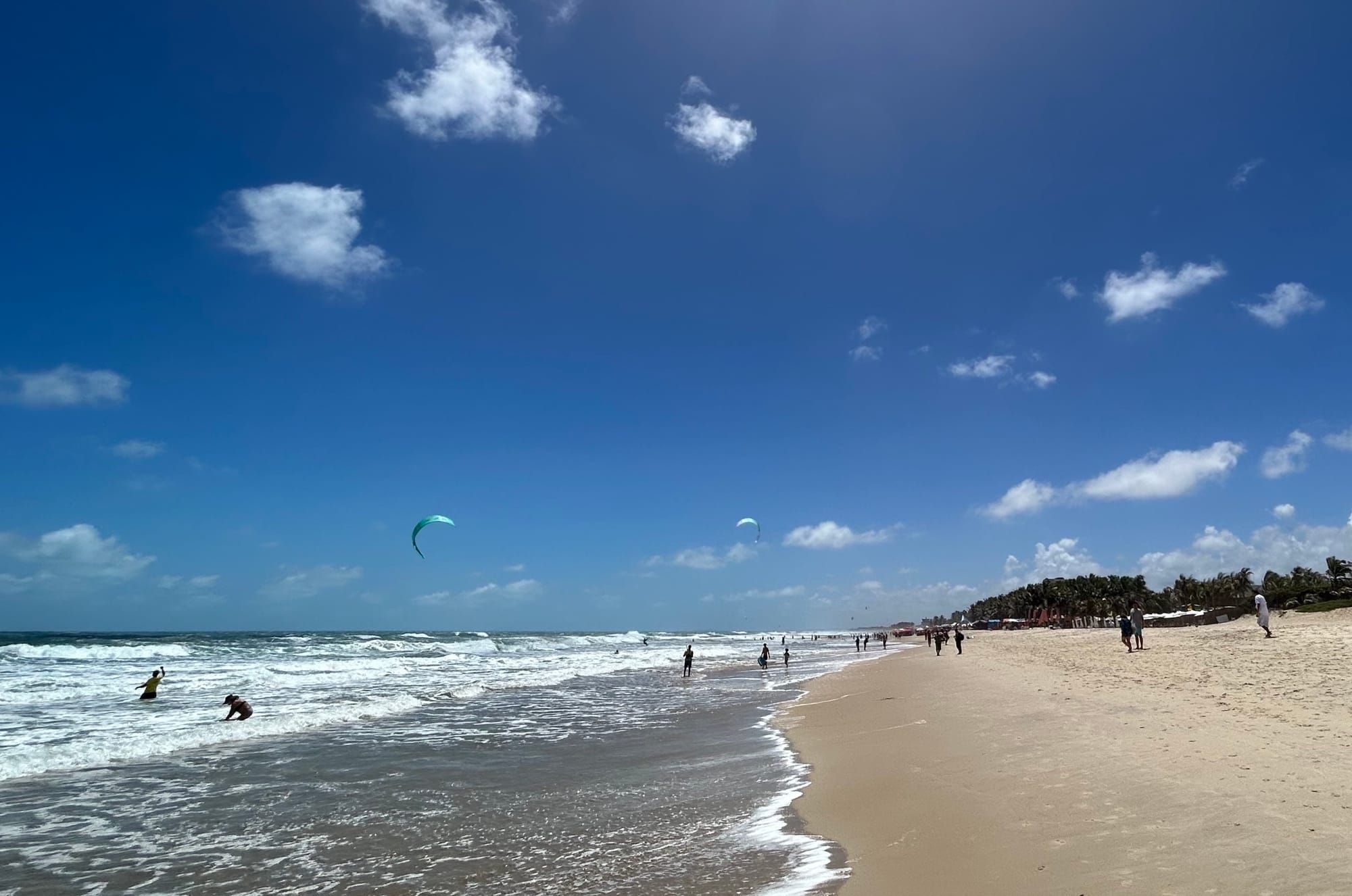
Almost every piece of data that leaves or enters Brazil passes through a strip of sand in Fortaleza. Sixteen submarine cables are in operation at Praia do Futuro, and close to 90% of the country’s international data traffic goes through them, according to NIC.br. No other city in Latin America has as many cables.
The next one already has a name: Synapse, from V.tal, which will link New Jersey to Praia Grande, in São Paulo, with a 460-kilometer branch to Fortaleza, designed for AI and cloud demand. Completion is expected between 2029 and 2030.
For a long time, the cable came ashore, the fiber went on to the Southeast, and the city was left with a sign on the beach. That began to change when data started to stay. Mega Lobster, opened in late 2025 at Praia do Futuro itself, is now the largest data center in operation in the Northeast, at 20 MW. At Pecém, the data center tied to TikTok is moving ahead, with 200 MW in its first phase, scheduled for 2027, and power from wind farms. In early October, the communications minister said the federal government wants to replicate this model across the Northeast.
This column asks what happens between the cable and the city. A data center employs many people to build and few to run: at Pecém, Omnia, the company behind the project, expects about 3,800 direct jobs during construction and 400 in operation. What stays in the territory depends on what grows around it: electrical and cooling maintenance, security, engineering, energy, technical training, and companies that turn proximity to data into an advantage.
A cable lasts about 25 years. That is how long Ceará has to decide whether it will be the beach the data passes through or the city where it works.
For decision-makers
A data center employs many people to build and few to run. What stays in the territory depends on what grows around it.
If you are 20
Who will keep these data centers running from 2027? Technicians in electrical systems, cooling and networks are the skills that will be in short supply, and training starts now.
Who should be talking
- Data center operators, technical schools and universities in Ceará. The technician who will be missing in 2027 has to start training now.
- Renewable energy generators and Ceará’s exporting industries. Anyone selling abroad has to prove clean energy to the buyer.
- Northeast software companies and cable and data center operators. Low latency only becomes an advantage when it becomes a product sold from here.
What to watch
- Second half of 2026: construction starts on V.tal’s Synapse cable.
- July 2027: first module of the Pecém data center.
- 2029–2030: expected completion of Synapse.
By Paulo Sombra, director of ISBR.
Know someone who should read this?
Get Vértice, ISBR’s weekly
Five minutes on capital, companies and territories. In Portuguese, every Tuesday.